Monday, September 12, 2011

Gospel Principles #40 - Temple Work and Family History (TBM Version)

For reference, see Temple Work and Family History in the Gospel Principles manual.

Introduction to the Lesson
In 1982, President Spencer W. Kimball announced a mission statement for the church. Since that time it has frequently been referred to as the "three-fold mission of the church." Ask the sisters if anyone remembers what the three elements of the church's mission are. Write them on the board as the sister's say them (making sure you keep them in order):
  1. Proclaim the gospel
  2. Perfect the saints
  3. Redeem the dead
Just as an FYI, in 2010, President Thomas S. Monson added an extension to the mission: caring for the poor and needy. (Write that on the board too.)

Today I'll use the church's mission as the organizing principle of my lesson today. My purpose will be to explore how temple work helps with all these aspects of the church's mission.

Proclaiming the Gospel

Let's start at the beginning with the first part of the mission: proclaiming the gospel. How does the temple help the church to proclaim the gospel? (Build on sister's responses.)

When I taught this lesson, some of the things that the sisters in my lesson mentioned were how temple open houses and visitor centers are great ways to introduce people to the gospel. They spoke about how the temple sits on a hill where everyone can see it and be curious about it. They also mentioned how often there is a lot of opposition to building temples in their immediate communities, but many local churches will often come to their defense and argue for their right to build the temple. So it becomes a way of bringing a community together and forming bridges with members of other faiths.

When the sisters were finished sharing their insights, I talked about how missionaries go through and get their endowment at the temple before leaving for their missions. I talked about how that endows them with the power they need as they go spread the gospel to others. I didn't read this quote, but this expresses the general idea of what I talked about:

A temple is a place in which those whom He has chosen are endowed with power from on high—a power which enables us to use our gifts and capabilities with greater intelligence and increased effectiveness in order to bring to pass our Heavenly Father’s purposes in our own lives and the lives of those we love...

President Benson has given us a promise about this. He said:

“Now, by virtue of the sacred priesthood in me vested … I promise you that, with increased attendance in the temples of our God, you shall receive increased personal revelation to bless your lives as you bless those who have died.” (Ensign, May 1987, p. 85.)

Come to the temples worthily and regularly. Not only do you bless those who are deceased, but you may freely partake of the promised personal revelation that may bless your life with power, knowledge, light, beauty, and truth from on high, which will guide you and your posterity to eternal life. What person would not want these blessings, as expressed by the Prophet Joseph Smith at the dedication of the Kirtland Temple. He said: “We ask thee, Holy Father, that thy servants may go forth from this house armed with thy power, and that thy name may be upon them, and thy glory be round about them, and thine angels have charge over them.” (D&C 109:22.)

That was a quote from David B. Haight in the April 1992 conference.

I also talked about how temples are symbols of the success of missionary work. A small branch becomes a ward which eventually becomes a stake which eventually becomes a temple district. So temples are symbols that the work has taken root in that particular area of the world.

Perfecting the Saints
How do temples aid in the perfecting the Saints? (Build on sister's responses.)

When I taught the lesson, the comments that were made were about how it takes a lot to be worthy of a temple recommend. You have to be living a certain way in order to even get in the door of the temple, so having the temple as a goal can help you live a better life.
We read a quote from the manual:
Temples of The Church of Jesus Christ of Latter-day Saints are special buildings dedicated to the Lord. Worthy Church members may go there to receive sacred ordinances and make covenants with God. Like baptism, these ordinances and covenants are necessary for our salvation. They must be performed in the temples of the Lord.

We also go to the temple to learn more about Heavenly Father and His Son, Jesus Christ. We gain a better understanding of our purpose in life and our relationship with Heavenly Father and Jesus Christ. We are taught about our premortal existence, the meaning of earth life, and life after death. (233-235)

I then briefly recapped what the quote said and tied that in with how that helps to perfect the Saints.

Then I mentioned how many people have positive experiences going through the temple, but not everybody has a positive experience at the temple---especially when they go through for the first time. Without talking about anything specific about the temple (because I know that makes some people uncomfortable), is there any general advice you would give to somebody who is struggling with the temple? What have you found helps you to have a meaningful experience at the temple? (Build on sister's responses.)

Some of the responses I got to that question was to have youth do their own family history work and perform baptisms for the dead with names they had found themselves. That way they'd feel a special connection to the ceremony and build positive experiences within the temple to prepare them to feel positive when they take out their endowment. Other suggestions were to talk regularly about the temple with your children and tell them that it's pretty much stuff they've been taught their whole life already. Other suggestions were to tell individuals going through the first time that they don't have to memorize everything and that there are attendants there to help them every step of the way. So they don't need to stress out.

When they were finished, I read a quote within a quote by David B. Haight (from the same talk): 

Elder Widtsoe thoughtfully provided some counsel about how you might do this. He spoke of the Prophet’s first vision as a model of how revelation, in the temple and elsewhere, is received.

"How do men receive revelations?" he asked. "How did the Prophet Joseph Smith obtain his first revelation, his first vision? He desired something. In [a grove of trees], away from human confusion, he summoned all the strength of his nature; there he fought the demon of evil, and, at length, because of the strength of his desire and the great effort that he made, the Father and the Son descended out of the heavens and spoke eternal truth to him."

Elder Widtsoe observed that it was the strength of Joseph’s desire and the great effort which enabled him to receive his vision of the Father and the Son. Desire and effort are likewise required if we would receive revelation to understand the ordinances of the endowment. He wrote: "Revelation... is not imposed upon a person; it must be drawn to us by faith, seeking and working.... To the man or woman who goes through the temple, with open eyes, heeding the symbols and the covenants, and making a steady, continuous effort to understand the full meaning, God speaks his word, and revelations come. ... The endowment which was given by revelation and can best be understood by revelation; and to those who seek most vigorously, with pure hearts, will the revelation be greatest."

I said that the symbols of the temple are kept sacred because the Lord wants to tell us what those symbols mean personally, through the Holy Ghost.

Redeeming the Dead
It's pretty obvious how the temple helps with the redemption of the dead since the temple is where vicarious ordinances are performed for the dead.

We read a quote from the lesson manual:
Many of our ancestors are among those who died without hearing about the gospel while on the earth. They now live in the spirit world (see chapter 41 in this book). There they are taught the gospel of Jesus Christ. Those who have accepted the gospel are waiting for the temple ordinances to be performed for them. As we perform these ordinances in the temple for our ancestors, we can share their joy. (236)

I talked about the concept of being Saviors on Mount Zion, which is a title that was sometimes used within the early church to refer to those who did ordinances in the temple for the deceased. What it means is that you are literally acting like the Savior when you are in the temple because you are making it possible for someone to enter the celestial kingdom---which is a service they cannot perform for themselves.

Another quote from the manual:

As members of The Church of Jesus Christ of Latter-day Saints, we have each been baptized and confirmed by one having the proper priesthood authority. Each of us may also go to the temple to receive the saving priesthood ordinances performed there. But many of God’s children have not had these same opportunities. They lived at a time or place when the gospel was not available to them.
Heavenly Father wants all of His children to return and live with Him. For those who died without baptism or the temple ordinances, He has provided a way for this to happen. He has asked us to perform ordinances for our ancestors in the temples. (233)

I waxed philosophical about how this is one of my favorite aspects of Mormon theology: the equity of the after life. If you didn't win missionary roulette, if you happened to live in a part of the world where the missionaries haven't come or if you just didn't get a chance to hear them in your lifetime, you still have a second chance to accept the gospel.

I then asked the sisters if they would be interested in sharing any stories when they felt connected to the spirits of the dead while they were doing temple work. That elicited some interesting stories.

Caring for the Poor and Needy?
I mentioned that I was really excited that President Monson had added the fourth element to the mission of the church, but that it makes it a little harder to connect the temple to the fourth one since it doesn't directly impact it. I then asked the sisters how they thought that the temple can help assist the poor and the needy.

The responses that I received from them were that the temple helps re-sensitize our hearts so that we are more in tune with the Spirit. It helps to begin to see people the way Christ sees them. It helps give us the spirit of revelation so that we can know what the needs of our immediate community are. And in the temple everyone is dressed the same, so there is no inequality; it shows the contrast between how the world looks at people (on their outward appearance) vs. how the Lord looks at us (at our hearts, as people with equal worth to Him).

I had planned some things to say about family history work, but we ran out of time. So I just concluded there with an admonition to go and participate in the temple more frequently.

Tuesday, August 30, 2011

Gospel Principles #39 - The Law of Chastity (NOM version)

I actually didn't teach this lesson in Relief Society. I was on vacation in Las Vegas last week and I got a substitute to teach my class. But my husband taught this lesson a few Sundays ago and when I read the lesson manual with him, I just knew I had to write a blog post about it.

The final paragraph of the lesson manual reads:
When we obey the law of chastity, we can live without guilt or shame. Our lives and our children’s lives are blessed when we keep ourselves pure and spotless before the Lord. Children can look to our example and follow in our footsteps. (232)

Unfortunately, the lesson manual's claim that obedience to the law of chastity helps individuals to avoid guilt and shame is not corroborated by scientific research. In fact, it appears that the opposite may be true.

In January 2011, Daniel Ray and Amanda Brown of Kansas University released a study called "Sex and Secularism: What Happens When You Leave Religion" about the impact of religion on attitudes towards sex. They surveyed approximately 14,500 individuals from a wide variety of religious backgrounds. Ray and Brown found that religious people had sex just as frequently as secularists (such as atheists, agnostics and Unitarians), that they engaged in the same kinds of sexual acts (masturbation, oral sex, pornography use) and often became sexually active at the same ages. But the study found that those who self-identified as religious experienced much more guilt associated with sex acts than their non-religious counterparts. Furthermore, religious people reported feeling significantly less satisfied with their sex lives than secularists.

But what was perhaps most interesting was the finding that 8.19 out of 10 Mormons experienced high levels of guilt and shame associated with sex---higher than any other religious group included in the survey. How can we make sense of the manual's promise that those who obey the law of chastity "can live without guilt and shame" when so many Mormons apparently experience the opposite? If chastity truly were a God-given principle, wouldn't it stand to reason that it would bring the greatest peace of mind and good mental health to those who tried to follow it? What accounts for this dissonance?

Mormons sacralize sex beyond a healthy, normal level
One one level, I think the problems come from the sacralization of sex. Mormons sacralize sex more than most religions do, meaning they identify it as a sacred, holy act more than many other religious denominations. Take Jeffery R. Holland's famous BYU talk "Of Souls, Symbols and Sacraments." Holland argues that the soul is both the body and the spirit and, because Christ paid for our souls through his Atonement and death, we do not own our own bodies. Because we do not own our bodies, we do not have the right to engage in sexual acts without the Lord's express approval (signified by the covenant of marriage). Holland also argues that sexual intercourse is a symbol of the total union between a husband and a wife---and that to pretend you are unified when you really are not (e.g. you didn't get married to solidify your commitment to one another) is sinful. And finally he argues that sexual intercourse is a holy sacrament, "symbolic of a union union between mortals and deity, between otherwise ordinary and fallible humans uniting for a rare and special moment with God himself and all the powers by which he gives life in this wide universe of ours." He argues that since sex is engaging in the act of creation, which is a God-like attribute, it is a sacred act that should only be engaged in under the boundaries that God has given it (e.g. marriage).

When I was a young adult (and a TBM), I thought this talk was simply beautiful. It appealed to my intellectual side by making sex an abstract, metaphysical act that had profound symbolic meaning. Having now experienced sex for myself, I don't really see sex as a spiritual act (although I know that it can have that feeling for some). I don't really feel like God is in my bedroom with me (and I kind of prefer to keep him out of it, thank you very much). Rather, I experience sex primarily as a physical act---something that's mostly fun (recreational) and can be used to solidify the bonds between me and my partner. I personally don't regret having "saved" myself for my husband so that we could grow closer by exploring our bodies sexually together, but I also don't fetishize sex and think of it as being greater than it is. It doesn't need to be a deeply symbolic, spiritual act to be meaningful and enjoyable for me. Thinking of it as a physically-stimulating, recreational activity doesn't lessen its importance. But the fact that Holland and other church leaders have put sex on such a holy pedestal becomes very problematic for those church members who treat Holland's words as scripture.

Speaking of scripture, here's another excerpt from the Gospel Principles manual:
The prophet Alma grieved because one of his sons had broken the law of chastity. Alma said to his son Corianton, “Know ye not, my son, that these things are an abomination in the sight of the Lord; yea, most abominable above all sins save it be the shedding of innocent blood or denying the Holy Ghost?” (Alma 39:5). Unchastity is next to murder in seriousness. (230)
The Book of Mormon's declaration that unchastity is nearly as serious as murder has the same function as Holland's talk: it's trying to make the act of sex seem sacred and special---it's just using negative terms rather than the positive terms that Holland prefers. Frankly, the analogy that sex is nearly as serious as murder just doesn't hold water for me. I can think of so many more sins that are much more heinous and that have much more serious, far-reaching consequences than sexual promiscuity. How about spousal or child abuse? How about kidnapping? Torture? Extortion? Armed robbery? Drunk driving? Embezzlement? Drug dealing? Sexual promiscuity just doesn't even seem to be in the same moral ballpark as any of these crimes---let alone murder.

The over-exaggeration of the seriousness of sex has caused many Mormons to develop skewed perspectives about human sexuality. For example, witness this statement from Bruce R. McConkie's Mormon Doctrine:
Loss of virtue is too great a price to pay even for the preservation of one's life---better dead clean, than alive unclean. Many is the faithful Latter-day Saint parent who has sent a son or a daughter on a mission or otherwise out into the world with the direction: "I would rather have you come back in a pine box with your virtue than return alive without it." (124)
While I'll cut McConkie a little slack for being from a different generation than my own, I can't help but feel that this line of thought is very disturbing. It's really not that far off from suggesting that people who break the law of chastity should be put to death. That's kind of messed up. And although I wish this were just an isolated statement made by McConkie alone, there have been nearly identical statements by Spencer W. Kimball, David O. McKay, and Heber J. Grant. When men who call themselves prophets make these kinds of statements, they have consequences. These sentiments ripple through Mormon culture for a long time and create problematic guidelines for the way we perceive and treat people who are sexually active before marriage (which, by the way, is almost everyone---including many Mormons). That's why sacralizing the act of sex---making sex into something more serious than it actually is---has profoundly negative societal consequences.

Virginity or bust
Another quote from the manual:
Satan not only encourages us to dress immodestly, but he also encourages us to think immoral or improper thoughts. He does this with pictures, movies, stories, jokes, music, and dances that suggest immoral acts. The law of chastity requires that our thoughts as well as our actions be pure. The prophet Alma taught that when we are judged by God, “our thoughts will also condemn us; and in this awful state we shall not dare to look up to our God” (Alma 12:14). (228)

The sister who taught this lesson in Relief Society on Sunday took a very hard-line approach to chastity, arguing that even having impure thoughts is a breach of the law of chastity. She further postulated that seeing anything of an erotic nature in the media was also a breach of the law of chastity because it leads to impure thoughts. I disagree. Thinking about sex and moderate sexual exploration is a fairly normal part of maturation. Sex is prevalent in the media because it is a part of the human experience. The only way to avoid sexual thoughts is to either repress them or be asexual. The only way to avoid seeing sexual imagery in the media is to consciously live in a cultural bubble with little interaction with the outside world. For that reason, this Puritanical, all-or-nothing, black-or-white, virgin-or-whore mentality is neither healthy nor realistic. [1]

One of the problems with the church's all-or-nothing approach to discussing chastity is that it begins with the assumption that those who are listening to their message have never experimented with sex before. Because the church fosters this all-or-nothing approach to human sexuality, it can be quite harmful to those who have experimented with sex prior to marriage. As I said before, it's fairly normal to think about sex and to experiment a little bit with sex. (I personally REALLY wish that teenagers would not experiment with full intercourse, but it does seem to happen regularly.) When those who have experimented with sex hear these all-or-nothing messages, it can cause them to experience the intense feelings of guilt and shame that the Kansas University researchers discovered. It can lead to feelings of worthlessness, of being dirty, of being broken, of being "used goods," of being a second-class citizen, etc. In other words, it can lead to a profound lack of self-esteem and depression. Although the church puts a band-aid on the problem by saying that repentance is possible, we all know that the religious concept of virginity is that it is something that you can never get back. This causes individuals to feel guilt and shame over things that are in the past and which are therefore beyond their personal control. Sounds like a good recipe for poor mental health to me.

The implications for LDS female sexuality

I recently listened to the audio book of How We Decide by Jonathan Lehrer. Lehrer discussed neurological evidence that shows human beings have what is called a "negativity bias." This means that humans perceive and remember negative experiences much more strongly than they remember positive experiences. A negative experience has to be counterbalanced with several more positive experiences in order for the negative associations to be undone. (This is why it takes 5 positive comments to undo a cutting remark made by a spouse, for example.)

In the context of sex, I think that this means that negative associations with sex are going to be much more powerful than positive ones. While it's true that most church leaders who give talks about chastity offer some lip service to the positive aspects of sex within the bonds or marriage, it's usually promptly followed up by lengthy, strongly-worded messages about the negative aspects of sex outside of marriage. Because of the human brain's negativity bias, it's very difficult for church members not to internalize the message that sex is wrong, bad, evil, dirty and immoral.

LDS females are the ones who are most negatively affected by this negative rhetoric. Generally speaking, the act of sex for most females has a much stronger psychological component than it does for males. The process of getting in the mood for sex and feeling aroused is a much more complex process for a female, as humorously parodied in this picture:


When females internalize the negative stigmas about sex that are promoted by the church, it makes it much more difficult for them to achieve the psychological state that is needed in order to have an enjoyable sexual experience. This phenomena has been documented by Dr. Jennifer Finlayson-Fife who did an in-depth qualitative study of several LDS women for her dissertation in psychotherapy. Finlayson-Fife found that many LDS women had a difficult time enjoying the experience of sex after having actively repressed their sexual feelings until marriage. They began to see sex as a marital duty rather than something that was personally fulfilling. As sex became a "chore" for them, it created a vicious cycle in which it was more difficult for them to desire and enjoy intercourse. This puts significant strain on their husbands in turn because it caused them to feel inadequate or undesireable. When there are problems in the bedroom, it causes a great deal of stress within a marriage. [2]


Pornography and masturbation could actually be good for you?
Again from the manual:
President Gordon B. Hinckley warned: “You live in a world of terrible temptations. Pornography, with its sleazy filth, sweeps over the earth like a horrible, engulfing tide. It is poison. Do not watch it or read it. It will destroy you if you do. It will take from you your self-respect. It will rob you of a sense of the beauties of life. It will tear you down and pull you into a slough of evil thoughts and possibly of evil actions. Stay away from it. Shun it as you would a foul disease, for it is just as deadly. Be virtuous in thought and in deed. God has planted in you, for a purpose, a divine urge which may be easily subverted to evil and destructive ends. When you are young, do not get involved in steady dating. When you reach an age where you think of marriage, then is the time to become so involved. But you boys who are in high school don’t need this, and neither do the girls” (in Conference Report, Oct. 1997, 71–72; or Ensign, Nov. 1997, 51).

I think it was probably under the Hinckley administration that the church ramped up its rhetoric against pornography and masturbation. This may have actually had the opposite effect that the church wanted it to have. A recent study released from Harvard found that Utah ranked the highest in online porn subscriptions compared to other states. This trend can probably be explained by some of the research that has been coming out of Utah State University recently. These researchers are finding that unhealthy use of pornography (which is defined as pornography use that interferes with healthy relationships, one's finances, or one's work responsibilities) is linked to the spectrum of obsessive-compulsive disorders. What this means is that when someone works really hard to suppress the desire to look at pornography, it actually leads to an increase in neurotic pornography abuse. Although it's very counter-intuitive, the way to stop the cycle of compulsion is to give into the desire and not obsess over it so much---to avoid imbuing it with intense negative emotions such as guilt and shame. Then it becomes much easier to stop engaging in the unhealthy behavior. That's exactly why the church's all-or-nothing, highly negative approach to pornography doesn't work: it actually causes the very behavior that it's meant to prevent.

The reality is that masturbation (which is usually closely linked to pornography use) is good for your mental and physical health. For men, masturbation promotes good prostrate health, oxygenates the body, and helps relieve stress. The myth that masturbation causes homosexuality (which used to be one of the widely-accepted theories about its causes) has been thoroughly debunked by peer-reviewed psychological research over the last two decades. For women, masturbation can help balance their hormones and assist with self-discovery about their bodies' erogenous zones (which leads to more effective partnered sex). Masturbation can actually be a healthy alternative to promiscuous sex because there is a 0% risk of contracting a sexually-transmitted disease or having an unwanted pregnancy.

Although I am strongly opposed to the porn industry's exploitation of women and their portayal as sex objects, there is some evidence that moderate pornography use can be beneficial as well. It's counter-intuitive, but some researchers have also found that pornography use actually decreases the risk of engaging in violent sexual acts against women. I think moderate use of erotica is probably acceptable.

In short, the church's stance on human sexuality is unrealistic and is not founded on factual evidence. I don't really know how the church could realistically update its stance on sexuality to be more progressive. Since what is appropriate and useful for one person is highly individualistic, human sexuality defies the black-and-white, rule-based system of morality that is favored by the church. I honestly can't see a way for the church to resolve these issues without becoming a completely different organization. But I do feel that the church's current stance on human sexuality is not sustainable for the future; many youth of the upcoming generations will likely become disillusioned with the institutional church as they begin to see for themselves that the emperor has no clothes.

Footnotes
[1] I think some of these societal attitudes may actually be the vestige of a pre-birth control society---when the act of sex had much more serious social consequences such as STDs and unintended pregnancy.

[2] Mormon Expression also had a great 2-part podcast episode about LDS Female Sexuality if you want to study this topic in more depth.

Tuesday, July 19, 2011

Gospel Principles #37 - Family Responsibilities (NOM version)

See my previous blog entry to see how I taught this lesson in Relief Society.

To be honest, I didn't strictly buy into the gender role stuff taught by the church even when I was a TBM. I think part of that stems from the fact that I've never been a typical female. I'm not a tom-boy or anything---it's more like I'm gender-neutral.

So is my husband. About a year ago, I was driving my husband to work when we saw a billboard advertising a Men's Expo. My husband asked me if I thought there was anything at a Men's Expo that would interest him. We couldn't come up with anything. He's just not very interested in any typically male things like sports, guns, barbecues, etc. Later on that week we passed a billboard for a Women's Expo. I asked him the same question about me and again we couldn't think of anything. I'm not interested in fashion, makeup, scrapbooking, crafts, etc. Those things bore me to death. I guess the point I'm making is that we're not your stereotypical male/female. And for that reason, statements about essentialized gender characteristics don't really resonate with me personally.

Now, that's not to say that I don't think that male and female anatomy has no impact on who we are at all. Sexual dimorphism is obviously real and I think there is plenty of evidence to show that your hormones can have a dramatic influence on your personality and tastes. But although you can make broad generalizations about male and female chemistry and its influence on personality, there are just so many individual exceptions to that rule as to make those generalizations almost meaningless. For example, my dad was pushing my 2 year old son on the swings at a playground the other day. When my son started to say "Hiwaa!" I told my dad that meant he wanted to be pushed much higher. Dad replied, "He's definitely a boy." Sure---but that does nothing to explain why my other son (who is 4) won't go within 2 feet of a swing without crying uncontrollably.

The Family: A Proclamation to the World is NOT Revelation
One of the things that is important to recognize about the Proclamation is that it is not an official revelation. Church policy dictates that in order for something to be accepted as part of the official LDS canon, it must be presented for a sustaining vote to the world-wide church membership during a solemn assembly. To date, this has never happened. This is probably because the First Presidency and the 12 Apostles did not receive the Proclamation as revelation; it was crafted by them as a committee. (Frankly, the entire document is riddled with Dallin H. Oaksey legalese.)

As further proof of the Proclamation's lack of canonical status, note the revisions made to Boyd K. Packer's infamous October 2010 Conference address. In the original speech as it was delivered verbally, Packer stated:
Fifteen years ago, with the world in turmoil, the First Presidency and the Quorum of the Twelve Apostles issued “The Family: A Proclamation to the World,” the fifth proclamation in the history of the Church. It qualifies according to the definition as a revelation and would do well that members of the church to read and follow it.

In the printed version of the address that was published online a week later, the last sentence of that paragraph was struck out and replaced with: "It is a guide that members of the Church would do well to read and to follow."

Downgraded from "revelation" to "guide" in just a week's time? Not surprising. Leaving the Proclamation's canonical status ambiguous is the church's way of having their cake and eating it too. They want the members to treat it as though it were revelation, to give it the deference of canonized scripture. But they know that it is not---or have they even attempted to give it official canonical status.

Nevertheless, the average TBM treats it with canonical status, which means the Brethren have succeeded in making it virtually canonized. The reverence that church members give to the Proclamation reminds me of an interesting comment made by Randall Paul on an episode of the Mormon Matters podcast. While discussing the deference that contemporary Mormons give to the General Authorities, Paul stated:
When I was growing up, the marker [of loyalty to the church] was the Word of Wisdom. It was not sexual morality and it had nothing to do with the authority of the prophet. But now the Word of Wisdom has become so ubiquitous in Western culture that we've lost that marker and we're searching for a [new] marker. And we want it to be that the prophet literally is out there healing people on the streets, having angelic visitations all the time, stories about Jesus appearing to him in the temple telling him when the Second Coming is coming. We want another section of the Doctrine and Covenants every couple of years. That's what we really want a prophet to be doing. If you're a prophet: deliver! To me, the further we get away from Joseph Smith, the more it's becoming obvious that the Ensign and the Conference talks are not the Doctrine and Covenants. So in our own hearts, we want to give more and more power to the prophet for whatever he does because we know that's part of Mormonism. That's our marker: that we have a prophet.

Could a dogmatic adherence to the Proclamation be part of a desire to overcompensate for our prophet? To see evidence of a living prophet to help us find comfort in proclaiming to believe in one?

Male Spiritual Inferiority?
One thing that I feel I should mention is that I added some heavy-handed discussions about maternal gatekeeping to my Relief Society lesson partly to counteract the strong male-bashing that had occurred in Relief Society the previous week (while discussing Chapter 36 - The Family Can Be Eternal). The sister who had taught the lesson was an older single woman and perhaps was a little bitter about that or something. Several comments were made about how men needed marriage in order to tame their selfish and anti-social impulses. Some of the comments from the sisters astounded me. A few highlights:
  • "My mother always used to say that an unmarried man over the age of 30 is evil."
  • "A man is like a grape. You have to squash him and squish him over and over. And, if you're lucky, you'll get a little bit of juice from him."
  • One woman told a story about how she came to hate her husband but stuck through the marriage so that her kids wouldn't have to go through a divorce. Yikes!
Not surprisingly given the tone of the most recent General Conference, single men received the brunt of most the blame for societal ills during the lesson. [1]

As a feminist, I basically don't believe that anyone should be limited or boxed in by their gender---male or female. Any kind of gender inequity or gender essentialization is flawed, in my opinion. But what is the source of all this male-bashing in a church context?

My money's on the priesthood, actually. The fact that the priesthood is only given to men brings gender inequality in the church to the forefront. (More on that in a minute.) Mormons acknowledge this inequity by talking regularly about why women don't need the priesthood to be equal. One of the ways Mormons have tried to cope with these stark inequities is to assert that males need the priesthood because they are spiritually inferior to women. So, in response to justifiable feminist critiques, Mormon culture has begun to posit that the priesthood is some sort of spiritual crutch for the weak, inferior male.

I frankly find that idea offensive. As a feminist, I believe in equality of the sexes; not that women should be given superior status over men. For that matter, I see no support for the idea of male spiritual inferiority in church doctrine. I think that men are just as innately capable of being a good parent, of expressing their feelings, of doing domestic chores, etc. If they are not, then I think social training is more likely to be the culprit than any kind of essentialized spiritual gender characteristics.

Presiding in Equality?
I mentioned earlier how the church tries to have its cake and eat it too by leaving the canonical status of the Proclamation in question. I think there are lots of other ways the Proclamation is an attempt by the church to have its cake and eat it too. The Proclamation wants to uphold traditional gender roles as having some sort of divine impetus while at the same time trying to deflect any criticism from feminists.

This tension is fairly obvious from this paragraph:
By divine design, fathers are to preside over their families in love and righteousness and are responsible to provide the necessities of life and protection for their families. Mothers are primarily responsible for the nurture of their children. In these sacred responsibilities, fathers and mothers are obligated to help one another as equal partners. Disability, death, or other circumstances may necessitate individual adaptation. Extended families should lend support when needed.

To me, this paragraph is contradictory. How can a father preside over his family and still be an equal partner with his wife? M-w.com says the word preside means "to exercise guidance, control, or direction" and "to occupy the place of authority." In fact, the word president and preside both from from the Latin root word praesidere (prae = "before" and sidere = "to sit," literally meaning "to sit before"). Praesidere originally meant to "stand guard" and it morphed into the French word présider by the 1600s which meant to "preside over, to govern." In short, the word "preside" is loaded with hierarchical intonations, implying one who is in a position of authority to make decisions and to rule over those that he governs. There's just no getting around that.

Now, let's take the most pro-feminist statement from the Proclamation (and which I made the star of the show in the lesson I taught in church): "In these sacred responsibilities, fathers and mothers are obligated to help one another as equal partners." Lest you think for a moment that this is implying that women can help their husbands do any breadwinning, there is a clarifying statement just afterwards that undercuts it, implying that only in situations of disability and death should there be any "individual adaptation."

In fact, one time (when I was still a TBM), I was having an argument about women working outside the home with a family member and I brought up the line about helping each other in their responsibilities from the Proclamation. My family member used the sentence about death and disability to argue that it wasn't the intention of the General Authorities to suggest women should work outside the home in any other circumstances except those ones. So, I guess that means it's okay for a man to help with the role of nurturing but it's inappropriate for a woman to help with the role of breadwinning? Seems like a convenient double standard to me.

Authority within Church Government

What I find most problematic of all is how a male-only priesthood plays out within church government. Women are virtually powerless to assert any change within the church. While an assertive woman can certainly speak her mind and offer a suggestion to a priesthood leader, the male has full control in deciding whether to implement that suggestion or not. It's true that most men in the church will never be in a position of authority in which they can implement changes in their church community---but they at least have the remote possibility they will one day be in a position of authority. By contrast, a woman has a 0% chance of being a position of authority. And that has serious ramifications for the church. If you deny half of your population a voice in how your institution is governed, you run the risk of being dramatically short-sighted in meeting individual needs. (I contend that a female prophet would NEVER have instituted the 3-hour block, for instance.)

That being said, I read an interesting piece in Mother Jones about how Christian mega-churches are targeting the male in the household most of all. They find that if they can get the father to come to their church, they've got the whole family. Perhaps it works the same way in our church. Could a male-only priesthood be so attractive to men that it makes them want to come to church, pay tithing, and do the whole rigamaroll---and bring their families with them? If so, maybe it's a necessary form of institutional self-preservation to deny women the priesthood. But even if that were true, it's no excuse for the frankly egregious gender gap that exists in this church.

Fortunately, one of the fringe benefits of losing  my faith is that I no longer have to do the mental gymnastics to make excuses for the poor treatment of women in the church any more. I no longer have to wrest the Proclamation until it is compatible with feminism. I can easily disregard it as being the product of a group of male geritocracy that actively tries to suspend the church's culture in the 1950s. I don't think it's out of a malicious intent to suppress women. I honestly think it's just that the 15 elderly men grew up in a different era and in a different time. They make certain assumptions about the world that someone who with a different life background just wouldn't make. And that's exactly why women are so badly needed in leadership positions.

Footnotes
[1] There was also a discussion during this lesson about how getting married earlier is better than getting married later in life because you "don't have time to develop negative personality traits that could hinder a marriage." That's just simply not true. Statistically, the highest predictors for marital success are having an education and getting married when you're 25 or older. I'm willing to bet that this statistic can largely be explained by the fact that the human brain is literally not fully developed until you're 25. It makes sense that someone with a steady income and a mature brain would have higher marital success.

    Monday, July 18, 2011

    Gospel Principles #37 - Family Responsibilities (TBM version)

    For reference, see Family Responsibilities in the Gospel Principles manual.

    To be honest, I'm too much of a feminist to deliver this lesson straight up the way it's supposed to be. So, this was one of those lessons where I pushed the envelope just a little bit.

    Introduction
    I started my lesson with a heavy disclaimer. I put a placard that said "The Ideal" up at the top of the chalkboard and then a placard that said "The Real" toward the bottom of the chalkboard. I talked about how there is a big gap there. And the topic of today's lesson tends to make that contrast feel very strong. Because today we're talking about The Family: A Proclamation to the World. (I then put the Proclamation up next to "The Ideal.") The Proclamation is a very idealistic thing. And, as such, it doesn't always correspond with our realities. I then put up a picture of a stressed-out mom next to "The Real."

    Our lives aren't perfect. Sometimes our relationships with our spouses or our children are difficult or frustrating. Sometimes we aren't able to get married or have a family. Sometimes we lose our spouse to death or divorce. Sometimes the people we love make choices we disagree with.

    It's hard not to see that as a personal failure. It's hard not to get depressed and feel like something's wrong with us because we're not perfect and we feel like we fall so short of the ideal. But I don't think that's how God sees us nor is it how he wants us to see ourselves. I think the important thing to remember is we talk about ideals in church to help us strive to be better, to make continuous daily improvements. But we don't need to think of ourselves as broken or as second-class citizens when we aren't perfect. Because every family, no matter how perfect they look on the outside, has problems, challenges, and things they struggle with. No one is exempt. And we would all do well to have a little charity for ourselves and for others as we muddle through this thing called life together.

    The Effect of Children on Marriage
    Next, I read several sections from the manual. It was the usual blah blah blah, the father presides and the mother nurtures the children. Yadda yadda yadda.

    I told them that this stuff is nothing new. Both of those sections quoted heavily from the Proclamation, which we're all very familiar with by now. So, that's the Ideal. What about the Real?

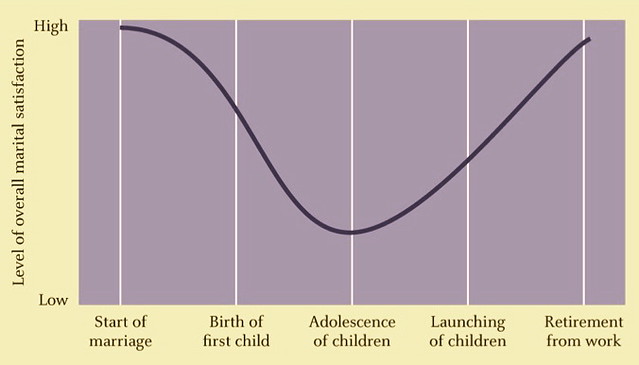
    I drew this graph on the board:


    Ever since it was first identified in the 80s, this trend has been documented by multiple studies across multiple disciplines. The research is pretty clear that kids seem to make your marriage less happy. I rehearsed a few theories about why this could be (kids monopolize your money, create more housework, cause boredom, etc.).

    Robert Miller, a BYU professor, likes to show this graph to his students and engage them in a discussion about it. Inevitably, one of his sassier students will ask: why have children at all? So I pose that same question to you: why have children at all? (Build on sister's responses.)

    Planning a Family
    What does the Proclamation say that can help you make this transition go a little more smoothly? (Here we read a section from the Proclamation that says families should plan to have children and make them a priority.) A landmark 10 year study done at the University of California at Berkeley that studied several aspects of marital happiness found that “couples who were ambivalent about parenthood, [who] disagreed about it, or who just ‘let it happen’ were far more likely to be unhappy and were at higher risk for divorce. Couples who planned a baby’s arrival or who were equally joyous at becoming parents were far more likely to maintain their marital happiness or even enjoy an increase after the baby was born" (from Tara-Parker Pope's For Better). So, if you plan for a family like the Proclamation says to, it will help make that transition go better.

    Sharing the Load in Parenting
    Now let’s read from my absolute most favorite part of the Proclamation. This part is super, super awesome. Right after the section where it talks about how fathers should preside and provide for their families and then it says mother should nurture their children, the next line of the Proclamation reads: “In these sacred responsibilities, fathers and mothers are obligated to help one another as equal partners.”

    Even though fathers have the stewardship over providing for their family and mothers’ stewardship is over the children, I think what this phrase is trying to suggest is that we don’t need to be so dogmatic in saying: “This is your job and this is my job and we CANNOT mix the two.” We help each other in our stewardships.

    Take, for example, the role of parenting. Even though the mother is responsible to nurture the children, that doesn’t mean the father should have no involvement with the children whatsoever. That would be ludicrous. Academic research has shown again and again that a father who is closely involved in the lives of his children has a dramatic impact on their health and well-being. (I then read several statistics that I took about the importance of having an involved father in the home from the US Dept of Health and Human Services.)

    Now here’s something that’s extra fascinating: the California Department of Social Services Office of Child Abuse Prevention funded a major study targeted at figuring out how to get fathers more involved in parenting. Without going into too many details, the study found that fathers had less parenting stress and marital happiness when they had support from their wives. Again, from Tara Parker-Pope:

    Now you’re probably thinking, of course his wife supports his effort to help more around the house. But studies show that’s not always the case. A difficult lesson many mothers have to learn is that they are bringing some of the parenting stress upon themselves by not ceding control from time to time. Women often complain that fathers don’t help enough, but when they do help, wives often unwittingly sideline their husbands, unintentionally discouraging them by micromanaging the way they wash the baby or change the diaper. …

    How many mothers have berated their husbands when they’ve come home and discovered him playing video games with the kids? It’s not that video games are banned—the game console is in the house, after all. But maybe the mom would rather see her kids reading or playing outside. Is it really fair to criticize her husband’s parenting style just because it’s different from her own?

    Studies show that the best predictor of a father’s involvement with his children is not the way he feels about his kids. The best predictor of a man’s parenting is his relationship with his wife. When the mother relinquishes her power and lets a father parent his own way, video games and all, he tends to be happier with the mother and more involved with his children.
    How have you found the balance described in the Family: the Proclamation to the World in your own family or how have you seen it working in other families that you might be familiar with? How have you found a way to be equal partners in fulfilling your divine responsibilities? (Build on sister's responses.)

    Sharing the Load in Housework
    Now, aside from saying that husbands and wives should be equal partners, the Proclamation is virtually silent on the issue of housework. I then cite statistics that say that women clearly do the majority of housework in the home---regardless of whether she is a stay-at-home mom, whether both she and her husband work, or even when the husband is the one who stays home. Since the perceived division of labor over housework is often a source of conflict in marriage, I provided the sisters with a chores worksheet that would stimulate a discussion about how fairly their chores are divided. I said they could possibly use it as a discussion to talk about fairness. For me, it helped me to realize just how much my husband really does help out that I don't necessarily give him credit for.

    Conclusion
    I then concluded by citing statistics showing how a happy marriage can be beneficial to your health in the long run.

    Wednesday, July 13, 2011

    Insomnia-Induced Fantasies

    I'm writing this at 3:00am on a weeknight. I'm suffering from one of my occasional bouts of insomnia. And in this sleep-deprived state I had a crazy fantasy about how I would leave the church.

    This train of thought began as I was contemplating the current state of our Relief Society presidency. The Relief Society president has been having really terrible health problems lately. I am not privy to what those health problems are, but they have caused her face to swell up so much that she doesn't even look like the same person any more. She has consequently been absent from church a lot. The other counselors have been having very spotty attendance as well because of health concerns or other reasons.

    The absence of leadership has been causing a lot of confusion and problems in communication. There was a recent mix-up over the lesson schedule that caused me to teach two weeks in a row---and one of the lessons I had to make up off the top of my head just a few days before teaching it. Plus, there have been other problems with communications about activities that have made it so that no one has shown up for the Relief Society Activities Formerly Known as Enrichment except the people presenting.

    Even though our current presidency has only been in for less than half a year, I have to wonder if it's possible they might get released. And in pondering that possibility, I began to have a fantasy in which the bishop called me to be the next Relief Society President.

    Let me be clear that I've never wanted to be Relief Society President---I never really wanted to be that engrossed in the church even when I was a TBM. But I've also always felt in my heart that I would make a really, really good Relief Society President. Part of me is sad that I can never be one now because, in all modesty, I seriously would have ROCKED at it.

    So here's how the fantasy goes:

    Bishop: Sister, we would like to extend a release to you from your current calling as a Relief Society teacher.

    Me (inwardly feeling a great sense of relief at having my last ties to the church finally cut): Thank you, Bishop. I gratefully accept this release.

    Bishop: And the reason we are extending this release to you is because we have a new calling in mind for you. The Spirit has told me that you should be the one who should serve as our ward's new Relief Society President.

    Me (chuckling with amusement): Well, Bishop, it's good that you are so in tune with the Spirit. I do think that I could do a good job as the Relief Society President. I'm a very well-organized person who puts 110% into everything I do. In particular, I would make it my mission to reach out to all the sisters in the ward. I would work my hardest to help every sister feel loved, appreciated and welcome at Relief Society. (Pause.) But I'm afraid that I cannot accept this calling.

    Bishop: Uhhh... Why not?

    Me: Because I don't believe in the church. At all. Not one bit of it. I haven't believed a word of it for at least a year now. I'm not even sure I believe that God exists any more. I've only been coming because I didn't want to make waves when I left. I just wanted to quietly recede into inactivity without anyone really noticing. But you've unfortunately forced my hand here. I'm sorry. What I'm going to do next will probably comes as quite a shock to you, but...

    (At this point, I take out my temple recommend and walk over to the Bishop's paper shredder and run it all the way through.)

    Me: From this point on, you will not see me here at church any more. I don't want you to try to talk me out of it. I don't want any home teachers or visiting teachers. I just want to be left alone. And I would also appreciate it if you never mention this conversation to anyone else. Sorry to drop such a bomb on you, but, well... That's how these things go sometimes. If you don't mind, I'd like to end this conversation here and I don't really wish to discuss it any further. And I do not authorize you to discuss this conversation with anyone else. Ever.

    (Walks out of office.)

    Ahhh, me.... Fantasies....

    Monday, June 27, 2011

    The Intimate Apparel Section

    You knew it had to come some time: the blog entry about garments. As of the writing of this blog, I haven't been wearing garments for about half the day now.

    For a long time now, I've sensed that taking off the garments would be the next logical step in my gradual extrication from the church and its culture. (The previous steps I've completed were to stop paying tithing and to start building a social network outside of the church.) This weekend I was thinking about the garments and wondering what was keeping me from taking them off. I certainly don't believe that the garments have any special protective power. And my temple covenants are meaningless to me. Furthermore, I never stopped wearing bras and underwear (I just wore them on top of the garments), so it's not like it was an issue of buying new clothing. What was really keeping me from doing it? When I would ask myself that question, I couldn't really think of an answer.

    I guess I've just been waiting for a reason to take them off. I suppose that I imagined some negative event at church would make me upset enough to take off my garments (rend my garments?) in protest. After all, I put them on for the first time as part of a religious ritual, maybe I should take them off as part of a de-religious ritual?

    But I've been entering a new phase in my relationship to the church. I guess you could call it apathy or just a general decrease in my personal interest in the church. Lately it feels like I haven't been as obsessed with the church and the level of emotion I've been less offended by my church meetings so much as I've been bored by them. I'm starting to adopt the attitude that the church as something that I used to do once,  but my life is changing now. And I'm developing new interests and I'm starting to find new things to occupy my time and thoughts. I guess I'm just gradually starting to let go.

    Today I was changing from my work attire to more comfortable attire at home. The garment bottoms were riding up inside of my jeans as I was putting them on and it occurred to me that I should just take them off rather than bother to do the same old readjustments where I try to pull them down to make them comfortable again. So, off they went. And then I took the top off too, for the sake of completeness.

    And it was just like that. No ceremony. No emotions. Just the mundane act of putting on underwear. It reminds me of a line from T.S. Eliot's poem "The Hollow Men": "This is the way the world ends. Not with a bang, but a whimper."

    Tuesday, May 24, 2011

    Things I've Said About Mormon Topics Recently

    Used with permission from xkcd.com

    This is just smorgasbord of comments that I've made in a few other forums (fora?) recently.

    My Relationship to the Church
    In response to an inquiry about my situations, thoughts and feelings about the church:

    For me personally, the most difficult thing about the LDS church is that I feel like it wants to have a parent-child relationship with me. (The institution is the parent and I am the child.) In essence, it's an infantilizing force. Now that I'm a 30-something, I'm ready to graduate beyond "gospel principles" and wrestle with the more problematic aspects of the church as a mature adult. As an academic, I place a high value on 1) independent thought, 2) developing empathy for people who are different from you or who may disagree with you, and 3) the ability to recognize that no issue is purely black and white, that nearly every issue is more complex than you initially thought it was before you began to examine it in more depth. I believe that thoughtful, well-researched dialogue (argumentation) is usually the best means to this end. It's a messy, uncontrollable process, but, at the end of the day, it is one which produces better people and institutions once they have gone through that crucible. Unfortunately, the correlated, authoritarian structure of the church is not conducive to producing an environment in which thoughtful dialogue can occur (or even a type of person who is capable of that kind of mindset). As such, Mormons like me and my husband are going elsewhere for our spiritual and intellectual stimulation.


    On McNaughton's Art
    In discussion with a friend on Facebook about Jon McNaughton's claim he is being censored by BYU:

    Oftentimes I find that Mormon culture is an extension or exaggeration of American's conservative culture at large. I am intrigued by the conservative impulse to read an "attack on conservative values" into what seems like a fairly a benign administrative decision. (It reminds me of the attack on Christmas that you hear about on Fox News every December.)

    I think that framing the issue as an "attack" is meant to function as proof that one's particular religious and political beliefs are ordained by God. The logic is that if something is from God, then Satan must obviously want to destroy it. Therefore, the existence of strong opposition to your cherished beliefs is further proof that your beliefs are of divine origin.

    Unfortunately, what these kind of "attack" paradigms really do is just create a red herring to distract us from any kind of meaningful, critical dialogue about the real issues at hand (e.g. does selling McNaughton's art mean that BYU endorses his political values and does it therefore constitute a breach of the church's politically neutral position, should BYU try to be considerate of a diverse range of political beliefs on its campus, analysis of the aesthetic value of McNaughton's artwork, etc.)

    For me personally, I remember going to the basement of the BYU Bookstore to buy my husband some lab goggles and seeing McNaughton's painting so prominently displayed. I distinctly remember feeling a profound sense of alienation when I looked at it, a deep sense of how much I didn't belong in a culture that celebrated a painting like that. I never complained to anyone about it, but maybe someone else who had a similar experience did say something.


    Perspectives on Inactive Single Women
    This next one was in a comment on a blog entry I wrote nearly three years ago about why 20-something single women go inactive. It's in response to a recent comment from a reader who said she left the church because she was tired of the strict family culture of her parents, which was fueled largely by their Mormon beliefs:

    A whole lot has changed in terms of my relationship to the church since I first wrote this blog entry three years ago. I'm going through a phase of transitional Mormonism where I am painfully aware of the church's "warts" that were completely invisible to me up until now. Some of those warts have been too big to ignore and have caused me to wrestle quite a bit over what I want my relationship with the church to be in the future.

    As part of this transition, I've been hanging out with a lot of liberal Mormons, New Order Mormons, Liahona Mormons, inactive Mormons, ex-Mormons, etc. And I've discovered that the Mormon community is far more diverse than I could have EVER imagined. I used to think of ex-Mormons as angry, bitter folks who just want to rebel or sin, who are so prideful that they are easily offended by something a church member or leader did. I used to define the world in terms of Mormon, ex-Mormon, and non-Mormon. I used to think that a Mormon was someone who subscribed to a particular orthodoxy and orthopraxy (strictness in belief and practice).

    I could not have been more wrong. Mormons, ex-Mormons---and all the many other shades of gray in between---are an incredibly diverse group of people. And they all have genuine reasons for believing and acting the way they do. Every single one of them. They're not being prideful. They're not ignorant. They're not sinful. Far from it. In reality, they're all decent human beings who are taking the course of action that makes sense to them in light of their life experiences and all the information that is available to them.

    The experiences you shared in your comment make a lot of sense to me in terms of explaining why 20-somethings are leaving the church (and despite my previous comments, I think that the 80% statistic might not be that far off from the truth).

    A few semesters ago, I received an email from the parent of one of my college students that was completely inappropriate. The parent told me he was convinced his 20-something daughter had been lying to him about attending my class. He demanded that I tell him whether or not his daughter was attending my class regularly and wanted to know what her current grade was. I emailed him and said that it would be a breach of the student's privacy to share that information with him, but I would be willing to meet with both him and his daughter if she gave her consent. (Incidentally, the student had not been attending my class for some time---and I never heard from either him or the student again.)

    The problem with this kind of parenting is the locus of both morality and control is in the parent. In a my-way-or-the-highway model of parenting (a strict, authoritarian, father-knows-best model of parenting), then, as Jane Nelson says, "it becomes the adult's responsibility to be constantly in charge of children's behavior." She writes: "The most popular form of excessive control used by parents and teachers is a system of rewards and punishment. With this system, adults must catch children being good so that they can give rewards and catch them being bad so they can dole out punishment. Who is being responsible? Obviously it is the adult; so what happens when the adult is not around? Children do not learn to be responsible for their own behavior."

    It makes sense that a lot of Mormon parents would try to be controlling parents because that is essentially the relationship the church currently has with its members: a parent-child relationship in which the church is the father-figure who tells us what to do and provides for our needs in return for our obedience (social needs being chief among them). The problem is that the church becomes the locus for control and morality---in other words it fosters a dependent relationship in which its members are not free to think for themselves, to act for themselves, and to define morality for themselves through their own experience and insights. This, to me, is one of the most disturbing aspects of the contemporary correlated church. And I don't begrudge anyone who chooses to leave that kind of an institution or that kind of a family.