Showing posts with label TBM version. Show all posts

Thursday, December 8, 2011

Gospel Principles #1 - Our Heavenly Father (TBM version)


Since I no longer serve as a Relief Society teacher in my ward, I'm going to start retroactively examining lessons that I taught in the past. I'll start at the beginning with my first lesson from the Gospel Principles manual.

This blog entry will examine how I taught this lesson originally in church. I'll post the "NOM Version" of this lesson in a few days. At the time I originally taught this lesson, I was a fully believing church member. My crisis of faith began about two months after teaching this lesson.

For reference, see Our Heavenly Father in the Gospel Principles manual.

Who is God?
I started the lesson by talking about how when my husband served his mission in Japan, he struggled to teach with the old-school missionary discussions because the first discussion operates on the assumption that you are already familiar with the Christian concept of God. For most Japanese people, their concept of God is so different from our own that it was difficult to even fathom what the missionaries were talking about. I then asked the sisters how they would explain the concept of God to someone who had never heard of him before---someone who has absolutely no concept of God. I listed the sister's responses on the boards. (I don't remember what they were any more.)

We then read the following paragraph from page 5 of the manual:
The prophets have taught us that God is the Almighty Ruler of the universe. God dwells in heaven (see D&C 20:17). Through His Son, Jesus Christ, He created the heavens and the earth and all things that are in them (see 3 Nephi 9:15; Moses 2:1). He made the moon, the stars, and the sun. He organized this world and gave it form, motion, and life. He filled the air and the water with living things. He covered the hills and plains with all kinds of animal life. He gave us day and night, summer and winter, seedtime and harvest. He made man in His own image to be a ruler over His other creations (see Genesis 1:26–27).

I emphasized that God is the creator and that Jesus Christ created the world under God's direction.

God is Our Spiritual Father
We then read the following passage from page 5 of the manual:
God is the Supreme and Absolute Being in whom we believe and whom we worship. He is “the Great Parent of the universe,” and He “looks upon the whole of the human family with a fatherly care and paternal regard” (Teachings of Presidents of the Church: Joseph Smith [2007], 39).

I reiterated that God is our Father. Because he created our spirits, he is our spiritual father in heaven.

I then had a few people in the class read Moses 1:27-33, 37. You can read it on your own if you want to, but it's basically God speaking to Moses saying that he created worlds without number, but "The heavens, they are many, and they cannot be numbered unto man; but they are numbered unto me, for they are mine." I talked about how there are so many people that they are numberless like the sands of the sea, but God knows each one individually and cares about them. That says a lot about our relationship to him.

God Has a Body of Flesh and Bones
We then read from page 6 of the manual:
Because we are made in His image (see Moses 2:26; 6:9), we know that our bodies are like His body. His eternal spirit is housed in a tangible body of flesh and bones (see D&C 130:22). God’s body, however, is perfected and glorified, with a glory beyond all description.
To add a little bit of humor to the lesson, I talked about how the first time I learned this principle was when I watched the Cecil B. DeMille movie The Ten Commandments and my parents took me aside to tell me that God actually has a physical body that resembles a human's---not like the pillar of fire depicted in the movie.

I then said to the class: "So, this is something that puzzles me. The doctrine that God has a human body is unique to our church. Joseph Smith learned this from the First Vision and we emphasize it heavily in our church. Why does it matter that God has a tangible body? Assuming he could still love, guide, and protect you without a body, what difference would it make if he were only spirit?"

I used the sister's responses to have a discussion about it. I don't remember what was said, but I have in my notes that one point I wanted to bring out was that it tells us about God's past and about what we each have the potential to become.

God is the Source of Everything Good
We then read from page 6 of the manual:
God is perfect. He is a God of righteousness, with attributes such as love, mercy, charity, truth, power, faith, knowledge, and judgment. He has all power. He knows all things. He is full of goodness.

All good things come from God. Everything that He does is to help His children become like Him. He has said, “Behold, this is my work and my glory—to bring to pass the immortality and eternal life of man” (Moses 1:39)
I had the sister's pick out the key words from that passage that told us about God's attributes and we listed them on the board: perfect, righteous, all-knowing, the source of everything good, etc. Once those were listed on the board, I talked about how these attributes were the reason why we worship God and also why we desperately need God's guidance in our lives.

Coming to Know and Love God
The final section of the lesson talks about the importance of coming to know God. We read from page 6 of the manual:
Knowing God is so important that the Savior said, “This is life eternal, that they might know thee the only true God, and Jesus Christ, whom thou hast sent” (John 17:3).

The first and greatest commandment is “Thou shalt love the Lord thy God with all thy heart” (Matthew 22:37).
The more we know God, the more we love Him and keep His commandments (see 1 John 2:3–5). By keeping His commandments we can become like Him.
I then said: "So, we need to know God better in order to become more like him and to learn how to love him. It's probably safe to assume that all of us in this room do believe in God. I want you to reflect for a minute on why you believe in God. What experiences have shaped your testimony of our Heavenly Father? What methods have you used that are helpful for drawing you closer to Heavenly Father?"

I just let the sister's share their experiences for the remainder of the lesson, building on what they said to bring out the four suggestions given by the lesson about how to come to know God:
  1. Believe that he exists and that he loves us
  2. Study the scriptures
  3. Pray to him
  4. Obey all his commandments
For #3, I had a note to myself to read this from the Bible Dictionary: “The object of prayer is not to change the will of God, but to secure for ourselves and for others blessings that God is already willing to grant, but that are made conditional on our asking for them.”

I had also written my own ideas for how to come closer to God:  writing a journal, being a parent, giving service, putting our wills on His altar, removing anything from our lives that can distract us from God.

I then bore my testimony and concluded. Pretty standard stuff. I seem to recall that it went well.

Monday, September 12, 2011

Gospel Principles #40 - Temple Work and Family History (TBM Version)

For reference, see Temple Work and Family History in the Gospel Principles manual.

Introduction to the Lesson
In 1982, President Spencer W. Kimball announced a mission statement for the church. Since that time it has frequently been referred to as the "three-fold mission of the church." Ask the sisters if anyone remembers what the three elements of the church's mission are. Write them on the board as the sister's say them (making sure you keep them in order):
  1. Proclaim the gospel
  2. Perfect the saints
  3. Redeem the dead
Just as an FYI, in 2010, President Thomas S. Monson added an extension to the mission: caring for the poor and needy. (Write that on the board too.)

Today I'll use the church's mission as the organizing principle of my lesson today. My purpose will be to explore how temple work helps with all these aspects of the church's mission.

Proclaiming the Gospel

Let's start at the beginning with the first part of the mission: proclaiming the gospel. How does the temple help the church to proclaim the gospel? (Build on sister's responses.)

When I taught this lesson, some of the things that the sisters in my lesson mentioned were how temple open houses and visitor centers are great ways to introduce people to the gospel. They spoke about how the temple sits on a hill where everyone can see it and be curious about it. They also mentioned how often there is a lot of opposition to building temples in their immediate communities, but many local churches will often come to their defense and argue for their right to build the temple. So it becomes a way of bringing a community together and forming bridges with members of other faiths.

When the sisters were finished sharing their insights, I talked about how missionaries go through and get their endowment at the temple before leaving for their missions. I talked about how that endows them with the power they need as they go spread the gospel to others. I didn't read this quote, but this expresses the general idea of what I talked about:

A temple is a place in which those whom He has chosen are endowed with power from on high—a power which enables us to use our gifts and capabilities with greater intelligence and increased effectiveness in order to bring to pass our Heavenly Father’s purposes in our own lives and the lives of those we love...

President Benson has given us a promise about this. He said:

“Now, by virtue of the sacred priesthood in me vested … I promise you that, with increased attendance in the temples of our God, you shall receive increased personal revelation to bless your lives as you bless those who have died.” (Ensign, May 1987, p. 85.)

Come to the temples worthily and regularly. Not only do you bless those who are deceased, but you may freely partake of the promised personal revelation that may bless your life with power, knowledge, light, beauty, and truth from on high, which will guide you and your posterity to eternal life. What person would not want these blessings, as expressed by the Prophet Joseph Smith at the dedication of the Kirtland Temple. He said: “We ask thee, Holy Father, that thy servants may go forth from this house armed with thy power, and that thy name may be upon them, and thy glory be round about them, and thine angels have charge over them.” (D&C 109:22.)

That was a quote from David B. Haight in the April 1992 conference.

I also talked about how temples are symbols of the success of missionary work. A small branch becomes a ward which eventually becomes a stake which eventually becomes a temple district. So temples are symbols that the work has taken root in that particular area of the world.

Perfecting the Saints
How do temples aid in the perfecting the Saints? (Build on sister's responses.)

When I taught the lesson, the comments that were made were about how it takes a lot to be worthy of a temple recommend. You have to be living a certain way in order to even get in the door of the temple, so having the temple as a goal can help you live a better life.
We read a quote from the manual:
Temples of The Church of Jesus Christ of Latter-day Saints are special buildings dedicated to the Lord. Worthy Church members may go there to receive sacred ordinances and make covenants with God. Like baptism, these ordinances and covenants are necessary for our salvation. They must be performed in the temples of the Lord.

We also go to the temple to learn more about Heavenly Father and His Son, Jesus Christ. We gain a better understanding of our purpose in life and our relationship with Heavenly Father and Jesus Christ. We are taught about our premortal existence, the meaning of earth life, and life after death. (233-235)

I then briefly recapped what the quote said and tied that in with how that helps to perfect the Saints.

Then I mentioned how many people have positive experiences going through the temple, but not everybody has a positive experience at the temple---especially when they go through for the first time. Without talking about anything specific about the temple (because I know that makes some people uncomfortable), is there any general advice you would give to somebody who is struggling with the temple? What have you found helps you to have a meaningful experience at the temple? (Build on sister's responses.)

Some of the responses I got to that question was to have youth do their own family history work and perform baptisms for the dead with names they had found themselves. That way they'd feel a special connection to the ceremony and build positive experiences within the temple to prepare them to feel positive when they take out their endowment. Other suggestions were to talk regularly about the temple with your children and tell them that it's pretty much stuff they've been taught their whole life already. Other suggestions were to tell individuals going through the first time that they don't have to memorize everything and that there are attendants there to help them every step of the way. So they don't need to stress out.

When they were finished, I read a quote within a quote by David B. Haight (from the same talk): 

Elder Widtsoe thoughtfully provided some counsel about how you might do this. He spoke of the Prophet’s first vision as a model of how revelation, in the temple and elsewhere, is received.

"How do men receive revelations?" he asked. "How did the Prophet Joseph Smith obtain his first revelation, his first vision? He desired something. In [a grove of trees], away from human confusion, he summoned all the strength of his nature; there he fought the demon of evil, and, at length, because of the strength of his desire and the great effort that he made, the Father and the Son descended out of the heavens and spoke eternal truth to him."

Elder Widtsoe observed that it was the strength of Joseph’s desire and the great effort which enabled him to receive his vision of the Father and the Son. Desire and effort are likewise required if we would receive revelation to understand the ordinances of the endowment. He wrote: "Revelation... is not imposed upon a person; it must be drawn to us by faith, seeking and working.... To the man or woman who goes through the temple, with open eyes, heeding the symbols and the covenants, and making a steady, continuous effort to understand the full meaning, God speaks his word, and revelations come. ... The endowment which was given by revelation and can best be understood by revelation; and to those who seek most vigorously, with pure hearts, will the revelation be greatest."

I said that the symbols of the temple are kept sacred because the Lord wants to tell us what those symbols mean personally, through the Holy Ghost.

Redeeming the Dead
It's pretty obvious how the temple helps with the redemption of the dead since the temple is where vicarious ordinances are performed for the dead.

We read a quote from the lesson manual:
Many of our ancestors are among those who died without hearing about the gospel while on the earth. They now live in the spirit world (see chapter 41 in this book). There they are taught the gospel of Jesus Christ. Those who have accepted the gospel are waiting for the temple ordinances to be performed for them. As we perform these ordinances in the temple for our ancestors, we can share their joy. (236)

I talked about the concept of being Saviors on Mount Zion, which is a title that was sometimes used within the early church to refer to those who did ordinances in the temple for the deceased. What it means is that you are literally acting like the Savior when you are in the temple because you are making it possible for someone to enter the celestial kingdom---which is a service they cannot perform for themselves.

Another quote from the manual:

As members of The Church of Jesus Christ of Latter-day Saints, we have each been baptized and confirmed by one having the proper priesthood authority. Each of us may also go to the temple to receive the saving priesthood ordinances performed there. But many of God’s children have not had these same opportunities. They lived at a time or place when the gospel was not available to them.
Heavenly Father wants all of His children to return and live with Him. For those who died without baptism or the temple ordinances, He has provided a way for this to happen. He has asked us to perform ordinances for our ancestors in the temples. (233)

I waxed philosophical about how this is one of my favorite aspects of Mormon theology: the equity of the after life. If you didn't win missionary roulette, if you happened to live in a part of the world where the missionaries haven't come or if you just didn't get a chance to hear them in your lifetime, you still have a second chance to accept the gospel.

I then asked the sisters if they would be interested in sharing any stories when they felt connected to the spirits of the dead while they were doing temple work. That elicited some interesting stories.

Caring for the Poor and Needy?
I mentioned that I was really excited that President Monson had added the fourth element to the mission of the church, but that it makes it a little harder to connect the temple to the fourth one since it doesn't directly impact it. I then asked the sisters how they thought that the temple can help assist the poor and the needy.

The responses that I received from them were that the temple helps re-sensitize our hearts so that we are more in tune with the Spirit. It helps to begin to see people the way Christ sees them. It helps give us the spirit of revelation so that we can know what the needs of our immediate community are. And in the temple everyone is dressed the same, so there is no inequality; it shows the contrast between how the world looks at people (on their outward appearance) vs. how the Lord looks at us (at our hearts, as people with equal worth to Him).

I had planned some things to say about family history work, but we ran out of time. So I just concluded there with an admonition to go and participate in the temple more frequently.

Monday, July 18, 2011

Gospel Principles #37 - Family Responsibilities (TBM version)

For reference, see Family Responsibilities in the Gospel Principles manual.

To be honest, I'm too much of a feminist to deliver this lesson straight up the way it's supposed to be. So, this was one of those lessons where I pushed the envelope just a little bit.

Introduction
I started my lesson with a heavy disclaimer. I put a placard that said "The Ideal" up at the top of the chalkboard and then a placard that said "The Real" toward the bottom of the chalkboard. I talked about how there is a big gap there. And the topic of today's lesson tends to make that contrast feel very strong. Because today we're talking about The Family: A Proclamation to the World. (I then put the Proclamation up next to "The Ideal.") The Proclamation is a very idealistic thing. And, as such, it doesn't always correspond with our realities. I then put up a picture of a stressed-out mom next to "The Real."

Our lives aren't perfect. Sometimes our relationships with our spouses or our children are difficult or frustrating. Sometimes we aren't able to get married or have a family. Sometimes we lose our spouse to death or divorce. Sometimes the people we love make choices we disagree with.

It's hard not to see that as a personal failure. It's hard not to get depressed and feel like something's wrong with us because we're not perfect and we feel like we fall so short of the ideal. But I don't think that's how God sees us nor is it how he wants us to see ourselves. I think the important thing to remember is we talk about ideals in church to help us strive to be better, to make continuous daily improvements. But we don't need to think of ourselves as broken or as second-class citizens when we aren't perfect. Because every family, no matter how perfect they look on the outside, has problems, challenges, and things they struggle with. No one is exempt. And we would all do well to have a little charity for ourselves and for others as we muddle through this thing called life together.

The Effect of Children on Marriage
Next, I read several sections from the manual. It was the usual blah blah blah, the father presides and the mother nurtures the children. Yadda yadda yadda.

I told them that this stuff is nothing new. Both of those sections quoted heavily from the Proclamation, which we're all very familiar with by now. So, that's the Ideal. What about the Real?

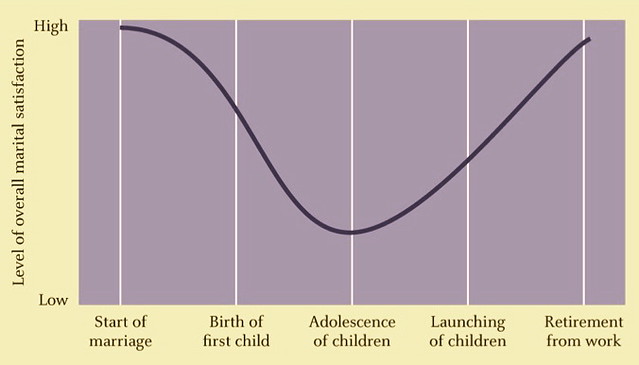
I drew this graph on the board:


Ever since it was first identified in the 80s, this trend has been documented by multiple studies across multiple disciplines. The research is pretty clear that kids seem to make your marriage less happy. I rehearsed a few theories about why this could be (kids monopolize your money, create more housework, cause boredom, etc.).

Robert Miller, a BYU professor, likes to show this graph to his students and engage them in a discussion about it. Inevitably, one of his sassier students will ask: why have children at all? So I pose that same question to you: why have children at all? (Build on sister's responses.)

Planning a Family
What does the Proclamation say that can help you make this transition go a little more smoothly? (Here we read a section from the Proclamation that says families should plan to have children and make them a priority.) A landmark 10 year study done at the University of California at Berkeley that studied several aspects of marital happiness found that “couples who were ambivalent about parenthood, [who] disagreed about it, or who just ‘let it happen’ were far more likely to be unhappy and were at higher risk for divorce. Couples who planned a baby’s arrival or who were equally joyous at becoming parents were far more likely to maintain their marital happiness or even enjoy an increase after the baby was born" (from Tara-Parker Pope's For Better). So, if you plan for a family like the Proclamation says to, it will help make that transition go better.

Sharing the Load in Parenting
Now let’s read from my absolute most favorite part of the Proclamation. This part is super, super awesome. Right after the section where it talks about how fathers should preside and provide for their families and then it says mother should nurture their children, the next line of the Proclamation reads: “In these sacred responsibilities, fathers and mothers are obligated to help one another as equal partners.”

Even though fathers have the stewardship over providing for their family and mothers’ stewardship is over the children, I think what this phrase is trying to suggest is that we don’t need to be so dogmatic in saying: “This is your job and this is my job and we CANNOT mix the two.” We help each other in our stewardships.

Take, for example, the role of parenting. Even though the mother is responsible to nurture the children, that doesn’t mean the father should have no involvement with the children whatsoever. That would be ludicrous. Academic research has shown again and again that a father who is closely involved in the lives of his children has a dramatic impact on their health and well-being. (I then read several statistics that I took about the importance of having an involved father in the home from the US Dept of Health and Human Services.)

Now here’s something that’s extra fascinating: the California Department of Social Services Office of Child Abuse Prevention funded a major study targeted at figuring out how to get fathers more involved in parenting. Without going into too many details, the study found that fathers had less parenting stress and marital happiness when they had support from their wives. Again, from Tara Parker-Pope:

Now you’re probably thinking, of course his wife supports his effort to help more around the house. But studies show that’s not always the case. A difficult lesson many mothers have to learn is that they are bringing some of the parenting stress upon themselves by not ceding control from time to time. Women often complain that fathers don’t help enough, but when they do help, wives often unwittingly sideline their husbands, unintentionally discouraging them by micromanaging the way they wash the baby or change the diaper. …

How many mothers have berated their husbands when they’ve come home and discovered him playing video games with the kids? It’s not that video games are banned—the game console is in the house, after all. But maybe the mom would rather see her kids reading or playing outside. Is it really fair to criticize her husband’s parenting style just because it’s different from her own?

Studies show that the best predictor of a father’s involvement with his children is not the way he feels about his kids. The best predictor of a man’s parenting is his relationship with his wife. When the mother relinquishes her power and lets a father parent his own way, video games and all, he tends to be happier with the mother and more involved with his children.
How have you found the balance described in the Family: the Proclamation to the World in your own family or how have you seen it working in other families that you might be familiar with? How have you found a way to be equal partners in fulfilling your divine responsibilities? (Build on sister's responses.)

Sharing the Load in Housework
Now, aside from saying that husbands and wives should be equal partners, the Proclamation is virtually silent on the issue of housework. I then cite statistics that say that women clearly do the majority of housework in the home---regardless of whether she is a stay-at-home mom, whether both she and her husband work, or even when the husband is the one who stays home. Since the perceived division of labor over housework is often a source of conflict in marriage, I provided the sisters with a chores worksheet that would stimulate a discussion about how fairly their chores are divided. I said they could possibly use it as a discussion to talk about fairness. For me, it helped me to realize just how much my husband really does help out that I don't necessarily give him credit for.

Conclusion
I then concluded by citing statistics showing how a happy marriage can be beneficial to your health in the long run.

Friday, April 1, 2011

Gospel Principles #32 - Tithes and Offerings (TBM version)

For reference, see Tithes and Offerings in the Gospel Principles manual.


Introduction to the Lesson
I usually start my lesson by just reviewing basic, key concepts about the gospel principle we are discussing that day. So I'd start by having someone read this section from page 185 of the manual:
In modern times the Prophet Joseph Smith prayed, "O Lord, show unto thy servants how much thou requirest of the properties of thy people for a tithing" (D&C 119, section introduction). The Lord answered: "This shall be the beginning of the tithing of my people. And after that, those who have thus been tithed shall pay one-tenth of all their interest annually; and this shall be a standing law unto them forever" (D&C 119:3–4). The First Presidency has explained that "one-tenth of all their interest annually" refers to our income (see First Presidency letter, Mar. 19, 1970).
Interestingly enough, the word tithe comes from the Old English word tegotha meaning "tenth."  

(NOTE: I would just define tithing as 10% and not go any deeper than that in my lesson. It's a good idea to avoid getting into a discussion about whether "tenth" can be defined as "net" or "gross" or some other definition. The church has made it clear that these kinds of decisions are best left up to the individual under the guidance of the Spirit.)

This isn't a question that I have an answer for, but have you ever wondered why the Lord chose 10% rather than some other number such as 3% or 7%? Do you have any opinions about why that might be? Give the sisters an opportunity to respond to the question. (This question will probably elicit a couple of funny remarks about 10% being easier for those of us who are mathematically-challenged, such as myself.)

When everyone has finished responding, I'll mention that I once read an interesting insight from Lauren F. Winner about why the Lord possibly requires 10%:
A 2005 Barna study suggested that "the typical individual gave away about 3% of their income." That figure is significantly less than the biblical standard of 10%. Why do Americans only give away 3% of our income? Because, though 3% might pinch, it doesn't pinch very much. 10% is harder. A commitment to give away 10% of your hard-earned salary requires serious self-sacrifice---it might require buying a smaller home, with a smaller mortgage payment. It might require scaling back vacation plans, passing on that trip to Europe and renting a modest house at the beach instead.  It might require telling your kids "no" more often. It might require a family of two kids and two adults to own only one car, and that car might not be a shiny, new SUV.
I liked that insight. It lead me to consider that perhaps one of the purposes of tithing is to help us learn how to be more prudent, to live within our means, and to avoid becoming too worldly or materialistic.


We Should Give Willingly
Next I would have someone read this section from page 186:
It is important to give willingly. "When one pays his tithing without enjoyment he is robbed of a part of the blessing. He must learn to give cheerfully, willingly and joyfully, and his gift will be blessed" (Stephen L Richards, The Law of Tithing [pamphlet, 1983], 8).

The Apostle Paul taught that how we give is as important as what we give. He said, "Let him give; not grudgingly, or of necessity: for God loveth a cheerful giver" (2 Corinthians 9:7).
So, as it says here in the manual, we should try to give our tithing cheerfully. One thing that I think is interesting is that prior to the turn of the twentieth century, the members of the church used to pay their tithing "in kind," which meant that they didn't always pay the church in cash. For example, if you were a chicken farmer, you paid the church with eggs. If you were a potato farmer, you paid with potatoes, etc. Back in those days, church members tried to pay the church with the best 10% of eggs or the best 10% of potatoes.

Since we give our tithing differently today, we don't have the same opportunity to give our "best" to the Lord. But one way we can give our best would be to give our tithing with a cheerful heart. (When I mentioned this to my husband, he jokingly suggested that perhaps you could write on the memo of your tithing check that it is "cheerfully given.")

Now, I don't know about you, but when I was a little kid and I was only making something like ten dollars a month, it was pretty easy to cheerfully give one dollar to the Lord. But now that I'm older and the checks I write are bigger, sometimes it's a little more difficult to give with a cheerful countenance. Maybe on occasion I murmur a little bit in my heart. Do you have any suggestions for helping to give cheerfully? Give the sisters an opportunity to respond to that question.

When everyone has finished responding, I might mention that I enjoy going to the Timpanogos Storytelling Festival every year. One of the most popular storytellers at the festival is Donald Davis. He tells a story about how he got his first job as a young teenager and began to notice that the government was taking money out of his paycheck, so that he wasn't getting the full amount he had earned. He complained loudly to his parents that he didn't like the government taking his money. So one day his father brought home a gigantic book called the Federal Budget. His parents told Donald to read through that book and find something in the budget he liked and just imagine that all of his money went to pay for that one thing. And after days of skimming through that big, boring book, Donald finally found something he liked: the national park system. So, now when he pays his taxes, he just imagines that all of his money is going to the national parks. (He makes jokes about how he likes to travel the country to go look at his "properties," such as the Grand Canyon and Yellowstone.)

Maybe that strategy could help us give tithing a little more cheerfully. Have the sisters come up with a list of the things that our tithing money helps pay for. Write their responses on the board as they come up with them. (If they get stuck while coming up with the list, they can use the list from the lesson manual on pages 186-187 for reference.) When the list is complete, ask: Can you find something on this list that you feel happy to have your tithing money pay for?

The sisters will probably put "temples" on the list at some point. Last year in one of my Sunday School classes when we were learning about Solomon's Temple, the teacher asked us why we make our temples so ornate, elaborate, and beautiful. It costs a lot of money to build a temple. Wouldn't it be better to spend that money on the poor? We ended up having a very thought-provoking discussion about that question (it's stayed in my memory and it’s been almost a year since we studied it). It might be interesting to have a discussion about that as part of your Relief Society lesson. For example, one of the interesting comments someone made was that we need to give first to the Lord. When we give Him our very best, He expands the usefulness of everything else we have and are.  When we give to the Lord first, we are more able to effectively give to the poor around us.


The Blessings of Tithing
As an introduction to this section of the lesson, I’d mention that the prophet Joseph F. Smith frequently spoke about the courage and faithfulness of his mother Mary Fielding Smith, the widow of Hyrum Smith. He told an interesting story about her faithfulness in paying tithes:
My mother was a widow, with a large family to provide for. One spring when we opened our potato pits she had her boys get a load of the best potatoes, and she took them to the tithing office; potatoes were scarce that season. I was a little boy at the time, and drove the team. When we drove up to the steps of the tithing office, ready to unload the potatoes, one of the clerks came out and said to my mother, "Widow Smith, it’s a shame that you should have to pay tithing." … He chided my mother for paying her tithing, called her anything but wise or prudent; and said there were others who were strong and able to work that were supported from the tithing office. My mother turned upon him and said: "William, you ought to be ashamed of yourself. Would you deny me a blessing? If I did not pay my tithing, I should expect the Lord to withhold His blessings from me. I pay my tithing, not only because it is a law of God, but because I expect a blessing by doing it. By keeping this and other laws, I expect to prosper and to be able to provide for my family" (in Conference Report, Apr. 1900, p. 48).
Next, I would have someone read from page 187 of the manual:
The Lord promises to bless us as we faithfully pay our tithes and offerings. He said, "Bring ye all the tithes into the storehouse, that there may be meat in mine house, and prove me now herewith … if I will not open you the windows of heaven, and pour you out a blessing, that there shall not be room enough to receive it" (Malachi 3:10).
The lesson manual says that the blessings of paying tithing are both material and spiritual. In what ways have you been blessed either temporally or spiritually by paying tithing? Have you put the Lord’s challenge to "prove" him on the principle of tithing? Do you have any personal experiences to share? Give the sisters an opportunity to respond to the question. I imagine that this will take up a very large portion of the lesson because nearly everyone has a tithing experience to share. However, if the discussion does stall, you might consider sharing one of your favorite stories from this Ensign article entitled “Not Room Enough to Receive It” in which many members throughout the world share their experiences getting blessings from paying tithing.

(NOTE: In this section of the lesson when discussing the blessings of tithing, I would try to avoid getting into "prosperity theology," which is the idea that people are wealthy because they are righteous or poor because they are wicked. It's for that reason that I would emphasize that some of the blessings that come from paying tithing are often spiritual, not necessarily financial.)

Another interesting side note to be aware of is that another instance in which God referred to opening up the windows of heaven was when talking about the Flood (see Genesis 7:11). So, when God speaks about opening up the windows of heaven and pouring out blessings in Malachi 3:10, He might mean that He will pour out a flood of blessings, a torrential downpour of blessings so great you will not be able to receive it. That's a cool metaphor, in my opinion.

If I still have time to kill at the end of the lesson, I really liked this question from the manual: In what ways is tithing a principle of faith more than a principle of finances? I think that could lead to a really interesting discussion.


Conclusion
I would conclude by reading this quote by Neal A. Maxwell:

I am going to preach a hard doctrine to you now. The submission of one's will is really the only uniquely personal thing we have to place on God's altar. It is a hard doctrine, but it is true. The many other things we give to God, however nice that may be of us, are actually things He has already given us, and He has loaned them to us. But when we begin to submit ourselves by letting our wills be swallowed up in God's will, then we are really giving something to Him. And that hard doctrine lies at the center of discipleship. There is a part of us that is ultimately sovereign, the mind and heart, where we really do decide which way to go and what to do. And when we submit to His will, then we've really given Him the one thing He asks of us ("Sharing Insights from My Life," BYU Devotional, January 12, 1999).

I would close by saying that it’s important to remember that everything we have is not really ours. They are things He has already given us. He asks such a small thing in return when he asks for our ten percent. But really, it's about training ourselves to become true disciples, to learn how to eventually give the bigger sacrifice of our wills.

Sunday, March 27, 2011

Gospel Principles #29 - The Lord's Law of Health (TBM version)

For reference, see The Lord's Law of Health in the Gospel Principles manual.


Introduction
Today we're talking about the Lord's Law of Health, which includes the Word of Wisdom. Of course the Word of Wisdom is one of the most visible and noticeable aspects of being a member of the church. I'm sure all of us have a story to share about a situation where we had to explain to someone why Mormons don’t consume alcohol or other things. And occasionally that can even lead to opportunities to explain our values and beliefs to people who aren't familiar with them.

On my 18th birthday, my boyfriend (at the time) took me to one of those Japanese tepanyaki restaurants where the chef cooks the meal in front of you. We were seated at the table next to a biker couple. When the waiters came and sang the birthday song to me, the biker couple asked me how old I was. "I'm 18," I said. They said, "Congratulations! Now you can smoke!" I told them that I didn't smoke. "Well, in 3 more years, you can drink!" I told them that I didn't drink. With crestfallen faces, they said: "I wish our kids said that that!"

Invite any sisters to briefly tell any funny or noteworthy experiences in which they had to explain that they didn’t smoke or drink.


Brief Overview of the Lord’s Law of Health
Well, because the Word of Wisdom is something that is so visible and distinct, it should be fairly easy for us to rattle off without any problems.

Write "Don'ts" on one side of the board and "Do's" on the other side of the board.

So, what have Latter-day scriptures and prophets told us about our health? As sister's come up with responses, write them down on the board. When finished, the list should look roughly like this:

Don'ts
  • Alcohol 
  • Tobacco 
  • Coffee 
  • Tea 
  • Drugs (except for medicine)
Do's
  • Fruits 
  • Vegetables 
  • Herbs 
  • Meat (but sparingly) 
  • Grains

Because I'm a bit of an environmentalist, I might possibly mention the "in season" aspect as being good for the environment.

Assign someone to read this quote from the lesson manual on page 170:
In addition to Doctrine and Covenants 89, other scriptures tell us how to be healthy. They tell us that we should "cease to be idle; cease to be unclean; … cease to sleep longer than is needful; retire to thy bed early, that ye may not be weary; arise early, that your bodies and your minds may be invigorated" (D&C 88:124). We are also told, "Six days shalt thou labour, and do all thy work" (Exodus 20:9). The Lord counsels us not to labor more than we have strength for (see D&C 10:4).

A latter-day prophet has told us that we should keep our bodies healthy. He counseled, "Nutritious meals, regular exercise, and appropriate sleep are necessary for a strong body, just as consistent scripture study and prayer strengthen the mind and spirit" (Thomas S. Monson, in Conference Report, Oct. 1990, 60; or Ensign, Nov. 1990, 46).
What do we need to add to our list on the board in light of what we just read?

Add to the Do's
  • Get appropriate sleep 
  • Nutritious meals 
  • Regular exercise
Add to the Don'ts
  • Idleness 
  • Uncleanliness 
  • Labor more than you have strength (overwork yourself)

Close this section by saying that, although it can be easy to live by the Word of Wisdom, we shouldn’t forget that last month we had a lesson about charity (our ward combined the lessons on service and charity). In that same vein, it's important to have charity towards individuals who may struggle with any aspect of the Word of Wisdom. (For example, I'd be willing to bet that it might be hard for some of us to exercise regularly. None of us is perfect.) We don’t know what people struggle with and I think it’s important to be understanding of different circumstances and to be compassionate. It takes a strong support system to recuperate from addiction.

Why should we keep the Word of Wisdom and what are the benefits?
Assign two different people to read this quote from the lesson manual on page 170 (I break it up into two parts because it's long):
Our Heavenly Father has given us health laws to teach us how to care for our bodies. The scriptures tell us about God’s laws: "No temporal commandment gave I … , for my commandments are spiritual" (D&C 29:35). This means that His commandments concerning our physical state are for our spiritual good.

When we keep the Lord's law of health and obey His other commandments, the Lord promises to bless us physically and spiritually.

Physically we have been promised good health. As a result of this good health we "shall run and not be weary, and shall walk and not faint" (D&C 89:20). This is a great blessing, but the spiritual blessings He has promised us are even greater than the physical ones.
The Lord promises us that we "shall find wisdom and great treasures of knowledge, even hidden treasures" (D&C 89:19). We will be taught important truths by the Holy Ghost through revelation. President Boyd K. Packer taught: "Our physical body is the instrument of our spirit. In that marvelous revelation the Word of Wisdom, we are told how to keep our bodies free from impurities which might dull, even destroy, those delicate physical senses which have to do with spiritual communication. The Word of Wisdom is a key to individual revelation" (in Conference Report, Oct. 1989, 16; or Ensign, Nov. 1989, 14).

The Lord also promises that the destroying angel shall pass us by. President Heber J. Grant said, "If you and I desire the blessings of life, of health, of vigor of body and mind; if we desire the destroying angel to pass us by, as he did in the days of the children of Israel, we must obey the Word of Wisdom; then God is bound, and the blessing shall come to us" (Teachings of Presidents of the Church: Heber J. Grant [2002], 192).
So, one of the main things I got out of that section of the manual is that our bodies and our spirits are connected.

I want to express this connection in a slightly different way. Have any of you heard of Maslow’s Hierarchy of Needs? I’m going to put an adaptation of his theory on the board:

Briefly discuss:
  • Physiological Needs (food, water, good air to breathe, good health) 
  • Safety (clothing, shelter, financial security, stable government) 
  • Love/Belonging (friendship, family, intimacy) 
  • Self-Esteem (confidence, respect of others) 
  • Self-actualization (creativity, spirituality)

NOTE: This is my own slight adaptation of the original theory. I'm putting health into the "Physiological Needs" when it was originally under "Safety." Also, I de-emphasize sex on the pyramid because, hey, I'm talking to Mormons after all.

Point out that we can’t achieve our highest potential if these basic physical needs are not being met. You know the saying: "When you haven't got your health, you haven’t got anything." I find that when I'm sick it basically keeps me from being able to do much else. So, naturally it makes sense that if our bodies are not in their best condition, it's more difficult to receive communication from God.

Our Bodies Are Temples
NOTE: This section of the lesson is 100% plagiarized from Whoa-man's post on the Exponent blog. It was really, really good.

I'm going to shift gears a little bit and it's going to seem like I'm going on a tangent when I'm not.

Show a picture of the temple. What are some words that you would use to describe the temple? Write sister’s responses on the board.

The very first line in this lesson manual says that our bodies are temples. (Pointing to the words on the board.) Have you ever used these same words to describe your own body? Read off the list of words they put on the board beginning with “My body is…”

Imagine how your lives would be different if you thought of your body as a temple. Literally. As temporal housing for a spiritual being. As a place for a god to dwell on earth. As the physical symbol of a divine purpose. As something to be treasured, respected, and cherished.

What are some of the other reasons you can think of for taking care of your bodies? What are some of the blessings or benefits that come from keeping the Lord’s Law of Health that you may have noticed in your life?

Conclusion
I'm going to close by reading this quote from Elder Bednar's talk "Ye Are the Temples of God," Ensign Sept. 2001):
I now want to try and explain a principle that is fundamental to our knowledge about and understanding of the importance of a physical body. The principle is this: Our bodies are not our own. First Corinthians 6:19–20 [1 Cor. 6:19–20] states:
"Know ye not that your body is the temple of the Holy Ghost which is in you, which ye have of God, and ye are not your own?

"For ye are bought with a price: therefore glorify God in your body, and in your spirit, which are God’s."

King Benjamin also taught with great clarity the truth that our bodies ultimately are not our own. In Mosiah 2:23–25 he describes how we are blessed through service and indebted to our God:

"And now, in the first place, he hath created you, and granted unto you your lives, for which ye are indebted unto him.

"And secondly, he doth require that ye should do as he hath commanded you; for which if ye do, he doth immediately bless you; and therefore he hath paid you. And ye are still indebted unto him, and are, and will be, forever and ever; therefore, of what have ye to boast?" …

Both our agency and our physical body, through which we exercise that agency in mortality, are truly "bought with a price" through the Atonement of Jesus Christ.
End by talking about how we have a responsibility to take care of our bodies because Christ has purchased them for us through the Atonement.